
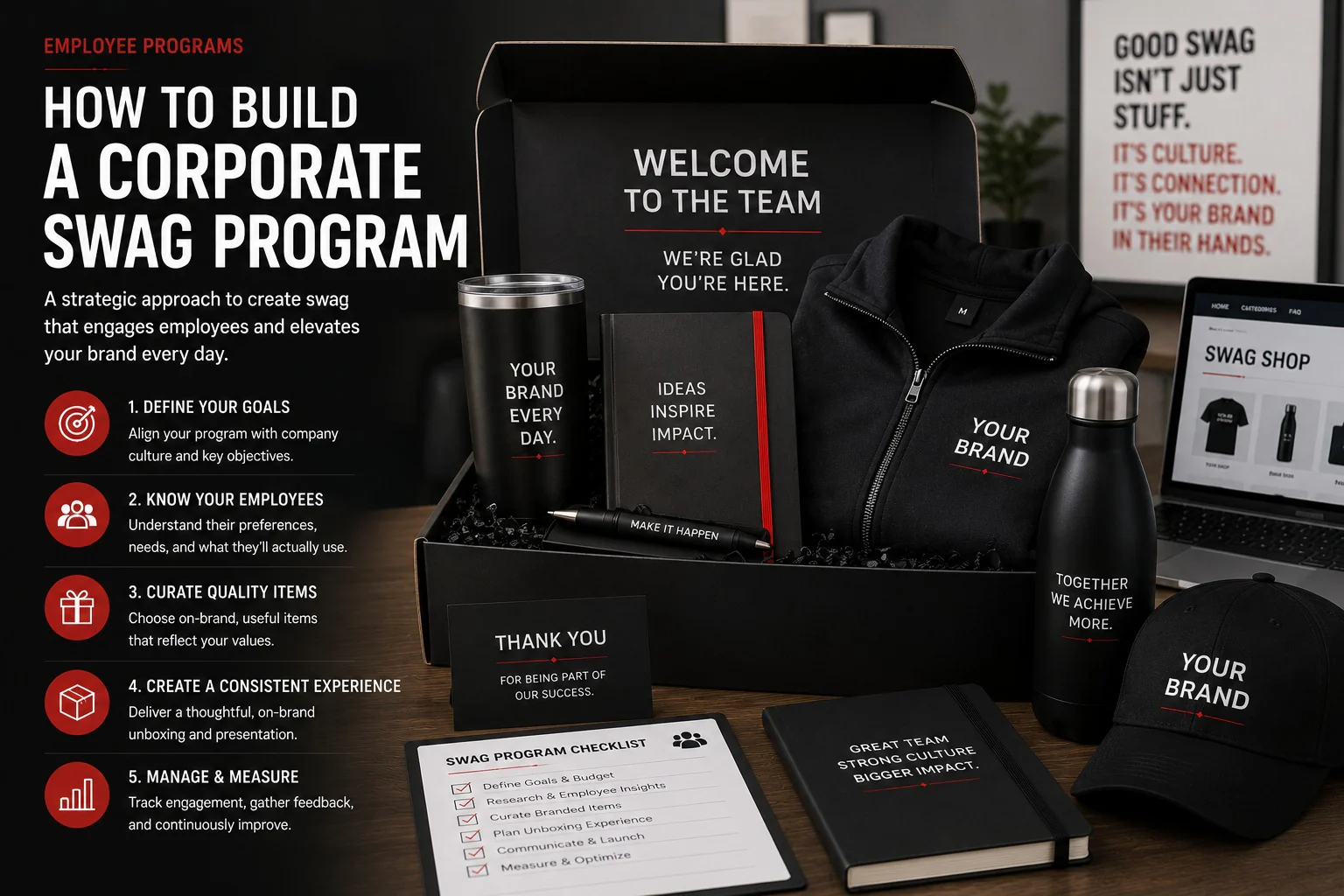
Most companies do not decide to run a swag program. They accumulate one: a batch of shirts for an offsite, a rush order for a conference, onboarding kits assembled by whoever had capacity. It works until the volume makes it somebody's second job.
A program is the point at which merchandise stops being a series of favors and becomes a defined thing with an owner, a catalog and a budget. Here is what that involves.
1. Find out what is already being spent
Before choosing anything, count what the company bought last year and who bought it. This is almost always the surprising step: spend is spread across departments, nobody has the total, and the same item has been ordered at three different qualities.
That number is what justifies the program, and consolidating it is usually where the savings come from — not from negotiating a better unit price.
2. Define a small approved catalog
The instinct is to offer a lot. Resist it. A tight catalog — one good tee, one hoodie, one bag, one bottle, one notebook — is easier to stock, cheaper per unit, and produces a coherent brand. Every additional item fragments the volume and adds a decision.
Choose for wearability and use, not for logo area. If nobody on the team would pick the item up in a shop, it will not be worn.
3. Lock the brand standard once
Agree the exact colors, the approved logo variants, and how the logo is applied to each item — then keep the digitized embroidery file and the color standard on record. This is what stops the second production run drifting from the first, and it is a five-minute decision that pays out for years.
4. Decide who orders, and how
This is the part that decides whether the program actually saves anyone time. The options, in increasing order of independence:
- One owner orders everything. Simple, controlled, and a bottleneck the moment they take leave.
- Requests through a form. Better, still manual.
- A private store. Teams order approved items themselves, against a budget, billed to their own cost center.
Once more than one team orders regularly, a store pays for itself in reclaimed time alone.
5. Produce once, store, and draw down
The tension in every program is that volume pricing wants a big order and reality wants forty units next Tuesday. Warehousing resolves it: produce the core range at volume, hold it, and ship on demand. Set reorder thresholds so restocking is triggered before you run out rather than after.
6. Make fulfillment somebody else's job
The hidden cost in most swag programs is assembly. Pallets arrive in a meeting room and someone spends a week packing and addressing boxes — labor that never appears in the budget and is the most expensive part of the program. Kitting and fulfillment removes that week entirely and drops the error rate at the same time.
7. Measure something
Pick two or three numbers and record them from the start: spend per head, how long a reorder takes, and whether items are actually being used. That last one is best judged by looking around rather than by survey. A program nobody wears is a budget line waiting to be cut.
Start smaller than you think
The common failure is launching with twenty products, a store and a warehouse before knowing what gets used. Start with the four or five items you are confident about, run them for a couple of quarters, and expand into the gaps that show up.
If you want help sizing one, tell us your headcount and how often you hire — those two numbers determine most of the design.