
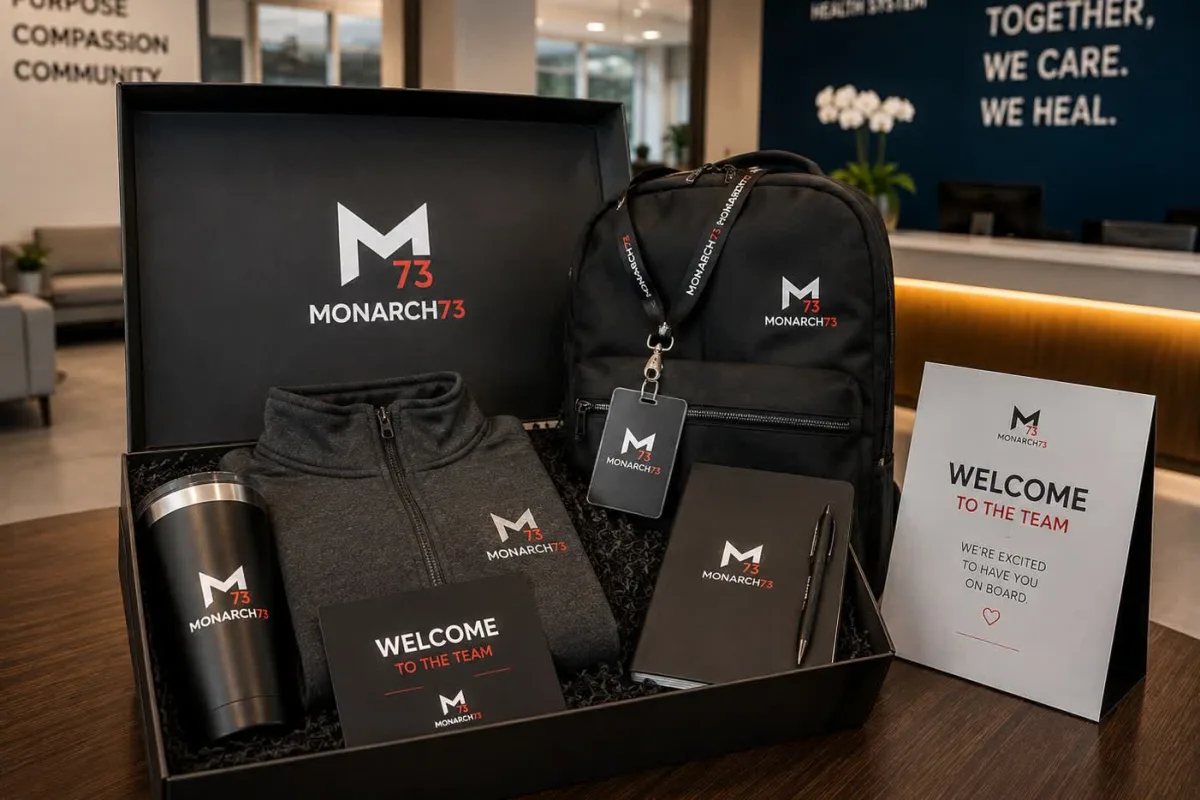
Most onboarding kit advice assumes a start date everybody shares. Healthcare does not work that way. People start in ones and twos, all year, across several facilities, and the kit has to be ready every time.
That changes the brief. The question is not what would make the best kit. It is what makes a good kit that can be assembled and shipped two hundred times a year without anybody assembling anything.
Start with what gets used on shift
A badge holder and lanyard, a decent water bottle, a good pen, a notebook. These are used the first week and kept, which is more than most onboarding merchandise achieves.
Outerwear is the item people actually value — a fleece or quarter-zip carries more goodwill than the rest of the kit combined, and it is the piece worn where other people see it.
Solve sizing before it becomes a spreadsheet
Apparel means sizes, and sizes are where onboarding programs quietly break. Collecting them by email and maintaining a list is a job nobody has time for, and the failure shows up as a new starter with the wrong size on day one.
Let the employee choose their own size and enter their own address. It is more accurate and it removes the task entirely.
Hold stock rather than reordering
Continuous hiring and per-order production do not fit together. A hire made three weeks before their start date cannot wait on a production run, so the kit either arrives late or is assembled from whatever is left.
Produce a run, hold it, and release kits against start dates. That is the whole difference between a program and a recurring scramble.
Say who it is from
A card that names the department and the person's role does more than a printed logo. It costs nothing and it is the part people keep.
We assemble and ship onboarding kits for healthcare organizations, and kitting and fulfillment covers how kits are built to a specification and shipped individually.